Why Federal AI Pilots Stall at Scale
The Problem in Numbers
Federal agencies are awash in AI pilots. The 2025 Federal Agency AI Use Case Inventory documents 3,611 use cases across 56 agencies—more than double the prior year.
But most of them stall.
HHS: Only 38.4% of 271 use cases reached operations and maintenance.
VA: 72 of 227 use cases retired within a single year.
Across all agencies: 41% are piloting. Only 8% have achieved scaled deployment.
This is not a technology problem. The models work. The infrastructure exists.
The problem is architectural, organizational, and programmatic.
The Core Issue: Handoff Failure
Pilots succeed at technical proof. They fail at transitioning to production.
A pilot team works around constraints for 90 days. A production system cannot.
When a pilot succeeds and leadership asks “can we move forward,” the production team encounters barriers the pilot team never faced:
- Security reviews become non-negotiable
- Manual data work becomes unsustainable at scale
- The contractor team departs
- The internal team lacks tools, training, and authority to operate
The pilot does not fail because it was poorly conceived. It fails because it was built outside the constraints production systems operate under.
The Five Structural Barriers
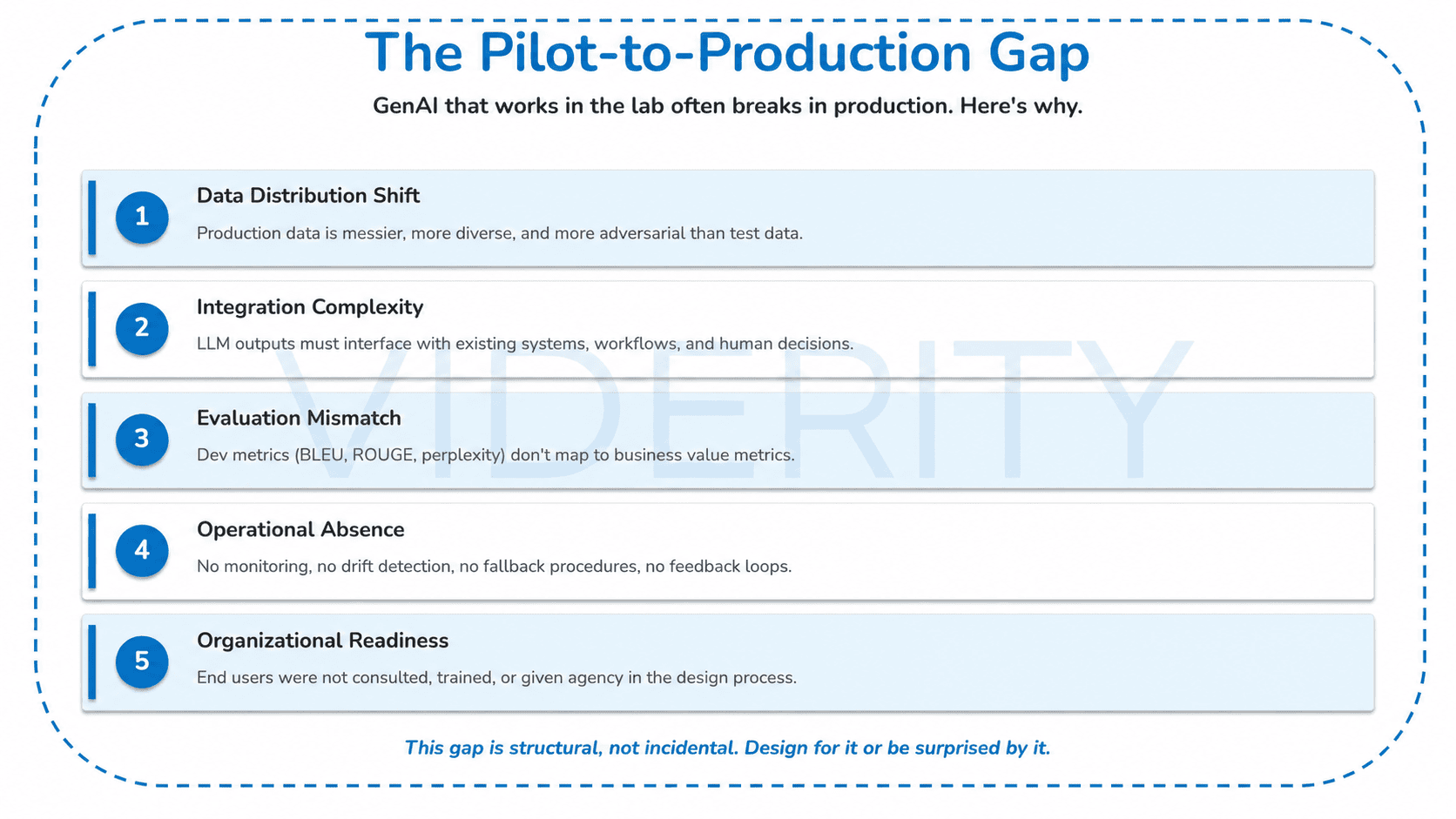
1. Data Distribution Shift
The Problem: Production data is messier, more fragmented, and more adversarial than pilot data.
In pilots, the data is curated: cleaned, labeled, structured for the model.
In production, data comes from operational systems optimized for transaction processing, not machine learning. It includes:
- Inconsistent definitions across systems
- Malformed records from legacy databases
- Data drift (patterns change after deployment)
Example: The IRS’s AI chatbot worked in the lab. Live questions revealed data far messier than the training set. Response-time requirements were incompatible with batch schedules.
How successful agencies solve it: Not with better tools. They change governance. They establish data stewardship roles, validation pipelines funded as operations (not pilot), and production data standards from day one.
2. Integration Complexity
The Problem: AI outputs must work with legacy systems, compliance workflows, and human decision-makers. Lab conditions do not exist.
Pilots optimize for accuracy. Production must optimize for integration:
- Output format must match downstream systems
- Decision authority must be clear
- Workflows must incorporate the model before deployment
- Override and escalation paths must work
Federal systems add layers: FedRAMP requirements, legacy ERP systems, compliance platforms, mission-critical workflows.
A model that works on a researcher’s laptop often cannot run on authorized cloud infrastructure without rearchitecture.
How successful agencies solve it: They identify operational workflows before the pilot ends. They validate the model’s output works with existing systems. They design for compliance integration, not compliance addition.
3. Evaluation Mismatch
The Problem: Technical metrics do not map to mission impact.
Pilots optimize for: accuracy, F1 score, AUC-ROC, perplexity.
But a 95% accurate model on a test set may still fail if that 5% error rate hits the cases that matter. A 30% faster response time is worthless if workflows cannot use it.
The federal twist: A model optimized for accuracy may fail compliance requirements. A model tested on a subset may introduce bias at full scale.
These failures are invisible in pilot metrics. They emerge in production.
How successful agencies solve it: They define success by mission outcome.
- A chatbot is successful if call volume drops 20% and satisfaction stays above 80%.
- A maintenance prediction system is successful if maintenance teams can act, budget allows procurement, and downtime actually decreases.
Not: “The model has 94% accuracy.”
Instead: “This saves us 2,000 call-center hours per year.”
4. Operational Absence
The Problem: No monitoring, no governance framework, no ATO pathway, no staffing, no incident response.
Production systems require operational discipline pilots do not.
Federal production systems require additional layers:
- Continuous monitoring (FISMA)
- Audit logging (NIST 800-53)
- Change control (FedRAMP)
- Incident response plans (compliance implications)
- Data retention policies (CUI)
- Role-based access control
Many pilots are built without this infrastructure. When the pilot succeeds, the operational team discovers they need to build all of this before the system runs in production.
This is not a technical problem. It is a budget and staffing problem. If the agency did not allocate money for it, it does not get built.
How successful agencies solve it: Operational infrastructure is a precondition of deployment. Monitoring, governance, and compliance controls are designed in from day one. The pilot already has the production foundation.
5. Organizational Readiness
The Problem: End users were not consulted. Operational teams lack budget and authority. Compliance boards not engaged early.
Successful pilots are often run by innovation offices or skunkworks groups. They exist outside normal hierarchy. They bypass standard processes.
When a pilot succeeds, it hits the organization it is meant to serve. That organization has its own structure, processes, governance. The pilot team has no authority inside it.
Real example: An agency’s transportation department built an AI system for equipment maintenance prediction. The pilot worked perfectly—identified failing pumps three weeks before failure.
But the maintenance organization lacked budget for spare parts. Operations lacked authority to adjust schedules. The pilot team had no way to force adoption.
The system was shelved.
How successful agencies solve it: They establish ownership within the operational organization before the pilot completes. They map workflows. They clarify decision authority. They secure budget and staffing commitments before deployment.
Why Handoff Fails: The Staffing Problem
Pilots hire deep specialists: ML engineers, data scientists, architects. Expensive, scarce, valuable, temporary.
Production needs different people: operators, program managers, compliance specialists, data stewards. People with authority to run systems day-to-day. People with continuity.
Successful agencies hire both. They hire hybrids who understand machine learning and federal compliance. People who can design the model and design the governance. People who speak both to data scientists and auditors.
These people are rarer and more expensive. But they enable transition without rebuilding the system.
The structural problem: Federal salary schedules do not accommodate hybrid expertise.
The solution: Blend staffing models.
- Federal employees for policy and governance
- Contractors for technical operations
- Hybrids that bridge both
Successful agencies staff for the long game from day one.
What Success Looks Like
Agencies moving AI beyond pilots share five characteristics:
- Executive sponsorship is structural
A senior leader owns the AI program. That leader has budget authority, staffing authority, decision-making power.
Pilots reporting to innovation offices fail. Pilots reporting to the operations leader who will run them move forward.
- Handoff plan exists before launch
The pilot team knows who runs it when done. The operational team knows what they are receiving. Production budget and staffing are allocated before pilot completion.
Transition is planned. Not improvised.
- Compliance is embedded
Infrastructure is authorized before the pilot starts. Data handling, logging, access controls are in place.
The audit trail is designed into the system. Not added later.
- Talent mix is intentional
The pilot team includes people focused on production. The production team is identified early. Hybrid specialists are in the staffing plan.
Continuity is planned.
- Scope is production-sized
The pilot is not a quick proof-of-concept rebuilt later. It is the first increment of production, tested at smaller scale.
Data governance, monitoring, change control, and incident response are designed for production constraints from day one.
What Agencies Must Do Now
Step 1: Name the production owner
Who runs this system when the pilot ends? Is that person involved now? Does that person have budget authority?
If the answer is “we’ll figure that out later,” the pilot is at risk.
Step 2: Map the compliance path
What frameworks apply? FedRAMP, CMMC, OMB M-25-21, NIST AI RMF?
What is the authorization timeline? Is your current infrastructure authorizable, or will you need to rebuild?
If rebuilding: what is the cost in time and money?
Step 3: Establish data governance
Do you know how messy production data actually is? Have you tested the model against production data?
Do you have a plan for validation, quality monitoring, retraining at scale?
Who is accountable for data quality?
Step 4: Staff for production
Does your pilot team include people focused on operational sustainability? Is your production team identified?
Do you have someone who understands both the model and federal compliance?
If staffing is entirely specialist-focused, plan for a hybrid hire before pilot completion.
Step 5: Fund the transition
Where does production funding come from? Is it allocated?
Will it be available when the pilot concludes?
If transition funding is uncertain, pilot success becomes a liability, not an asset.
For Vendors Responding to RFPs
The vendors winning federal AI contracts are not promising breakthrough models.
They are proving they can handle the handoff.
That means:
- Demonstrated FedRAMP authorizations
- Experience with OMB M-25-21 requirements
- Staffing models that sustain production operations
- Documented success moving pilots to production
- Willingness to staff for compliance alongside capability
Agencies evaluating proposals should ask: “Which vendor understands my compliance requirements, has staffed similar transitions, and can commit to the production infrastructure I need?”
The Viderity Approach: Federal AI Transition Services
Most agencies treat pilot-to-production as something that happens after success.
Viderity treats it as the primary work. The Federal AI Transition program embeds governance, compliance, and organizational integration into the pilot itself.
The approach combines three elements:
- Program management discipline
- Federal compliance expertise (FedRAMP, NIST, CMMC, OMB M-25-21)
- Operational readiness (data governance, staffing, organizational embedding)
The program runs parallel to the pilot. Not after it.
What this means in practice:
Compliance and ATO pathway are mapped before pilot launch. Infrastructure for production is selected before development starts. FedRAMP authorization proceeds in parallel, not in queue.
Data governance is built from day one. Data stewardship roles, validation pipelines, and production standards are established immediately.
Staffing for handoff is planned at kickoff. Hybrid staff are embedded during development. The production team is seeded during the pilot.
Operational readiness is tested throughout. Monitoring, incident response, change control, and governance boards are operational by pilot completion.
Organizational embedding is intentional. End-user workflows are mapped. Decision authority is clarified. Budget and staffing commitments are secured before deployment.
The difference: This is not about accelerating pilots. It is about ensuring pilots survive their own success.
Agencies running pilots without explicit handoff plans are at risk. The technical work gets done. The business case is clear. But structural barriers remain unaddressed until production, where they become blockers.
The Federal AI Transition program treats those barriers as primary work. By pilot completion:
- The path to production is clear
- The compliance foundation is in place
- The operational team is ready
- The infrastructure is authorized
The pilot does not stall. It scales.